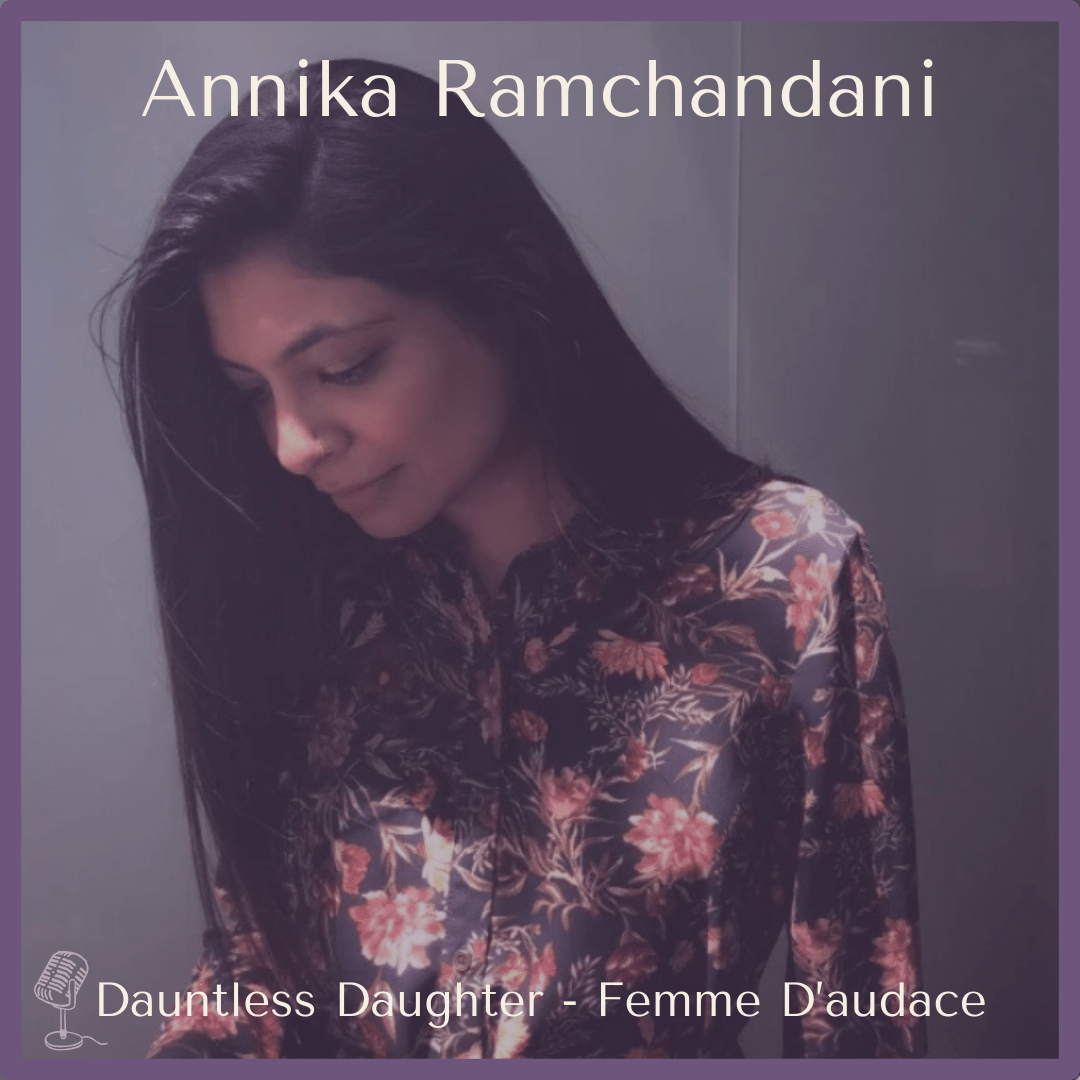
Annika has been a good friend of mine for over a decade now and it doesn’t take a genius to figure out why: she’s funny, creative, caring, intelligent and driven. Born in the Middle East, raised in Toronto, she came to Montréal at the ripe age of 25 to take on a job as a junior copywriter in a major advertising agency: Publicis Montréal.
After a short career in journalism, Annika discovered her love for the advertising world during an internship in a major Toronto agency. Though she had been hired to work on the project management side of things, she set her sights on the creative department. Turning down a solid job offer at the end of her internship, she went on to learn the craft at Humber College in Toronto with a one-year post-graduate certificate in copywriting. Though it was a highly intensive program, they teach students how to build a solid portfolio, and thanks to it—and a personal recommendation from the program coordinator at the time—Annika was sought out for a junior copywriter position by Publicis.
Her arrival in Montréal presented several challenges, the first being the language barrier. Though she’d lived in France for a year, the French in Québec is extremely different. Annika was also confronted to the fact that, unlike in Toronto, being an English copywriter in Montréal is an anomaly. Even as an English writer, working on English campaigns, colleagues and clients are more often than not native French speakers with varying levels of mastery of the English language. It is not rare to have to present, explain, and sell English concepts in French. She quickly realized she had to step up her game in terms of understanding French.
It’s a good thing she is equally as flexible and smart and as she is charming. Annika worked extra hard to master the language through intensive classes and sheer will, but also made many French friends who helped her. Without her natural curiosity and appetite to learn a new language, she wouldn’t be where she is today: fluently bilingual and with a strong network to boot.
Annika is proof that there are indeed many groups and cultures living in Montréal; our population is far from being comprised of only native Québécois French speakers, yet it can be hard for those who don’t fit this description to find their place in the city, let alone in the province. So it was important that not only her French friends helped her settle in, but also to make sure she kept her community of anglophone writers – her petits bijoux, as she calls them – close.
But Annika isn’t just an anglo woman in Montréal. She is a brown woman in Montréal, working in a predominantly white industry. And if things have evolved since her arrival, certain codes still remain in the advertising industry, which means she had to prove herself more, speak louder, hold her ground a little firmer, and generally try harder than most.
Though she did not face overt racism in Montréal, she did get a lot of underhanded slaps from both colleagues and friends. It’s to be expected in a society where so many kinds of racisms have been internalised and normalised. She used to laugh it off, knowing real harm was rarely intended, but as she’s matured, she speaks up against it more. Rather than take the “jokes” in good stride, she now turns to a more direct but educational approach so that people can better understand the weight their words can bear and the true meaning of seemingly harmless comments.
Through these challenges, she took it upon herself to learn more on Quebec’s culture, to truly learn the language, and to really hone her craft before showing it off. She climbed the ranks over the years, going from junior writer, to intermediate, to senior, before finally becoming ACD at Sid Lee. She did what she does best and let her talent speak for itself. She also met an ECD who truly believed in her and who looked past conventional ways of thinking to give her the opportunity to contribute and bring a fresh perspective to the table. Annika considers herself lucky to have someone who saw that and who fought for her.
Though the advertising industry remains a very male-dominated, white-dominated domain, EDI efforts have multiplied in the last few years. We can see a desire to shift the board. What needs to be done? According to Annika – who is herself part of the EDI panel at her agency – there is a need to re-evaluate the mindsets and constructs that have been in place for so long and which have become a normalized part of the culture. By bringing more diverse points of view to the table, we can better educate people and help them truly understand different cultures. It’s important to keep the focus on talent and ideas at work to avoid tokenism as well as discrimination: when everyone fulfils a clear, legitimate role, when they serve a true purpose, we can stop focusing on appearance.
There is still a lot of ground to cover, but those who dare to do the heavy lifting will lead the way and perhaps one day we can all see other cultures as a natural part of society.
It’s that very idea of mixing of minds and perspectives that she loves so much about working in big advertising agencies. In her creative process, she loves to deep dive into research, and then seek out colleagues from different areas of expertise who have different ways of seeing the challenge – and solving it.
But the fast paced, high-pressure environment of agencies is fertile grounds for burnouts. Annika, like many others, pushed herself to the breaking point. In trying hard to do it all and to never let anyone down, she herself broke down. Though mental health discussions are much more open and healthier nowadays, back then, it was still taboo, which left her feeling ashamed and led her to cut herself off from everyone around her. Then, the stress of it all made her come back to work too soon – only a month into her sick leave, when the doctors had recommended, she rest for three. This, she regrets, wishing she had been able to listen to herself better.
I asked her how she was able to go back, and how she is still able to love her job after going through something like that. The hardest part, she says, was that she had lost that flame inside of her that drove her and fed her creativity. It was very scary, but slowly, as she healed, that spark came back, and she made sure she nurtured it. Annika learned a lot from her experience. It was hard, but it was a wakeup call that taught her some very valuable lessons: the power of saying no, of setting boundaries, and listening to herself.
Advertising is a highly competitive field, and these are lessons many learn the hard way. But the truth is that is you learn to say no, you learn not to spread yourself too thin. That’s how you always deliver your best work – which is what employers and clients truly need. Jobs will come and go, but a person’s willingness to create is what is most valuable. Besides, there is always a solution. Annika’s burnout has influenced her experience as a leader, allowing her to recognize the signs in herself and others, and giving her some tools to guide them through it.
Her advice: Speak your truth. As long as you arrive with intent and purpose, chances are you’ll be heard and accepted. That being said, always be respectful when you do it.
Don’t be afraid to seek out mentors, whether they are your seniors, or the other way around – we have so much to learn from each other.
Listen to the full episode here
Follow Annika on Instagram and LinkedIn.
Discover her Timeless Project: https://www.instagram.com/timeless.channel/
Resource shared during the episode:
 Julia Lemyre-Cossette